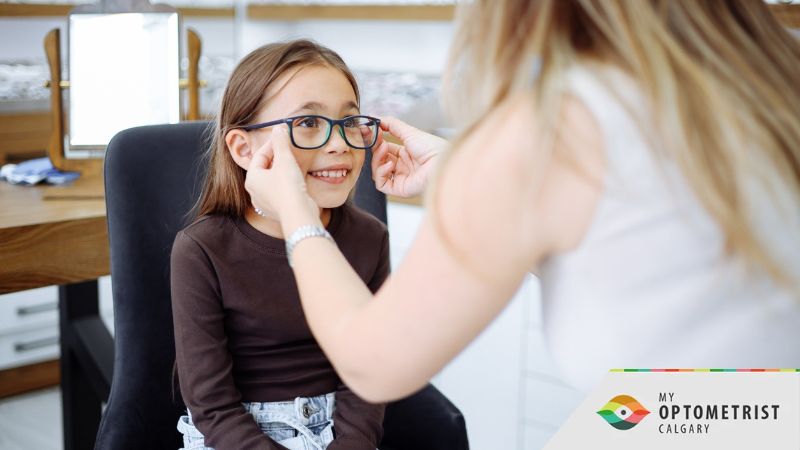
A changing glasses prescription can leave parents wondering whether there is more they can do to support their child’s vision. Myopia control focuses on slowing the progression of nearsightedness while maintaining clear vision for school, sports and everyday activities.
A myopia management clinic assesses your child’s prescription, eye health, vision history and risk factors before recommending suitable care. Depending on their needs, options may include specialized glasses, soft contact lenses, orthokeratology or prescribed atropine drops. Regular monitoring helps your optometrist assess progress, review comfort and adjust treatment when appropriate.
At My Optometrist, we help families understand their options and what ongoing care involves. Learn what to expect from an assessment, how treatments differ and why follow-up matters.
Understanding Myopia
When your child needs a stronger glasses prescription, it is natural to wonder whether anything can help slow those changes. Clear vision matters for school, sports and everyday activities, but updating glasses is only one part of the conversation about childhood nearsightedness.
Myopia control focuses on slowing progression rather than simply correcting blur. A myopia management clinic assesses your child's vision, reviews risk factors, discusses suitable treatments and monitors changes over time. The goal is an informed plan that supports clear vision while addressing ongoing progression.
For families exploring myopia control, understanding what an appointment involves can make the next step easier. At My Optometrist, we help parents understand their child's findings and consider options based on age, prescription, eye health and daily routines.
Myopia, commonly called nearsightedness, makes distant objects appear blurry. A child may see a nearby book clearly while struggling to read a classroom board or recognize details across a playing field. However, children do not always recognize or report that their distance vision has changed.
Myopia commonly involves an eye that has grown too long, causing light to focus in front of the retina. It often develops during childhood and can progress as children grow. An examination can establish whether myopia is present and whether other factors affect your child's vision. www.opto.ca
Some changes parents might notice include:
- Squinting
- Closeness
- Blur
- Difficulty
These observations are reasons to arrange an examination, rather than enough information to diagnose myopia at home. For example, sitting closer to a television can have different explanations. Describe the behaviour and let your optometrist assess what it means.
Ordinary prescription glasses help a child see clearly, but standard single vision correction does not provide the same function as a treatment designed to slow myopia progression. Understanding that difference helps parents ask whether their child's care plan includes correction alone or active management.
The reason to discuss progression extends beyond stronger lenses. Higher levels of myopia are associated with increased risks of conditions such as retinal detachment, glaucoma and myopic maculopathy. This does not mean a child with myopia will inevitably develop those problems. It explains why clinicians take progression seriously. www.opto.ca
Starting the conversation early gives your optometrist an opportunity to assess the situation and explain available approaches. You do not need to wait until your child's prescription becomes high before asking about management.
Family history is also relevant. Tell your optometrist whether either parent is nearsighted and bring previous prescriptions or examination records if available. These details can help establish a clearer picture of your child's vision history.
A useful consultation should leave you understanding the diagnosis, the purpose of any proposed treatment and the next review. Ask for explanations in everyday language so both you and your child can participate confidently.
Myopia Treatment Options
A myopia management assessment considers more than a prescription number. Your optometrist reviews your child's age, previous progression, eye health, visual habits and practical needs. Where available, axial length measurements can help track changes in the length of the eye alongside prescription findings.
Ask which measurements the clinic uses and how they will be compared at future visits. Establishing a baseline makes later discussions more meaningful because treatment decisions can reflect recorded changes rather than impressions alone.
My Optometrist lists several approaches to myopia control, including specialized glasses, daytime contact lenses, orthokeratology and atropine drops. Availability and suitability should be confirmed during your consultation, since a treatment that suits one child may not suit another.
Topics to discuss include:
- Glasses
- Contacts
- Orthokeratology
- Atropine
Specialized myopia control glasses use lens designs intended to influence progression while correcting vision. They differ from ordinary single vision glasses. Your optometrist can explain the specific design recommended, how it should be worn and what evidence supports its use.
Myopia control soft contact lenses provide another approach for suitable children. Assessment includes whether the child and family can manage insertion, removal and hygiene reliably. Your clinic should explain the prescribed wearing schedule and what to do if discomfort develops.
Orthokeratology, often shortened to ortho-k, involves specially fitted rigid lenses worn overnight to temporarily reshape the cornea. This can provide daytime vision correction without wearing those lenses during waking hours. It may also help slow progression in suitable children, but requires careful fitting, hygiene and follow-up.
Atropine drops may be considered as part of a prescribed management plan. Their effect depends on factors including concentration, and they do not replace glasses needed for clear distance vision. Potential side effects include light sensitivity and blurred near vision, which should be discussed before treatment begins.
Research supports considering several interventions, but treatment effects vary and evidence has limitations. A Cochrane review highlighted uncertainty around some options and longer term outcomes. Avoid interpreting a percentage from an advertisement as a prediction of your child's personal result. www.cochrane.org
Ask your optometrist why a particular option is recommended, what alternatives exist and how benefits and risks compare. Discuss total costs, replacement supplies and appointment requirements so the plan feels manageable beyond the initial visit.
Monitoring And Support
Myopia management is an ongoing process. After treatment begins, your optometrist needs to review both its effectiveness and your child's ability to use it comfortably and safely. The right schedule depends on the treatment, clinical findings and any concerns that develop.
International Myopia Institute guidance generally recommends assessments at least every six months during treatment, with additional early visits for some approaches. Your child's individual schedule may differ, particularly during contact lens fitting or when a treatment is changed.
Follow-up conversations should cover:
- Progression
- Comfort
- Adherence
- Safety
Be honest if the routine is difficult. Missed drops, inconsistent glasses wear or problems handling lenses are useful information, not something to hide. Your optometrist can explain whether changes to the routine or treatment should be considered.
Ask how progression is being measured and what findings would prompt a review of the plan. Slowing progression does not necessarily mean every measurement will remain unchanged. Equally, clear vision through glasses does not establish whether eye growth is adequately controlled.
Daily habits belong in the conversation as well. Spending time outdoors is associated with a lower risk of developing myopia, with stronger evidence for delaying onset than for controlling established myopia. Outdoor activity complements professional care rather than replacing prescribed treatment. opticians.ca
Discuss ways to balance sustained near activities with breaks and outdoor opportunities. Reading and schoolwork remain important, so focus on practical routines rather than blaming a child or assuming that screens alone explain their prescription.
Families considering myopia control should also understand what happens when treatment is adjusted or stopped. Ask about ongoing monitoring, because progression can change and some treatments may be followed by rebound. Decisions about stopping should be made with your optometrist rather than based only on convenience.
Before leaving, confirm your next appointment and ask how to contact the clinic between visits. Keeping a record of questions, symptoms and challenges can help you remember important details and make future conversations more useful for your whole family.
Contact My Optometrist to discuss myopia control and arrange an assessment for your child. Our team can review their vision history, explain suitable treatment options and outline a monitoring plan that helps your family make informed decisions about ongoing eye care.
FAQ's:
Q: CAN MYOPIA CONTROL CURE NEARSIGHTEDNESS?
A: No. Myopia control aims to slow progression rather than cure nearsightedness or reverse existing eye growth. Children still need appropriate vision correction. Your optometrist can explain realistic treatment goals and monitor changes in prescription and, where available, eye length to assess progress. www.opto.ca
Q: WHEN SHOULD MY CHILD START MYOPIA MANAGEMENT?
A: Discuss management when myopia is diagnosed or your child’s prescription begins changing. You do not need to wait for severe nearsightedness. Your optometrist will consider age, family history, examination findings and progression before recommending treatment or an appropriate monitoring schedule. opto.ca
Q: ARE CONTACT LENSES THE ONLY TREATMENT OPTION?
A: No. Options may include specialized glasses, myopia control soft contact lenses, orthokeratology and prescribed atropine drops. Suitability depends on your child’s findings and ability to follow the treatment routine. Your optometrist can explain the benefits, risks and responsibilities associated with each appropriate option.